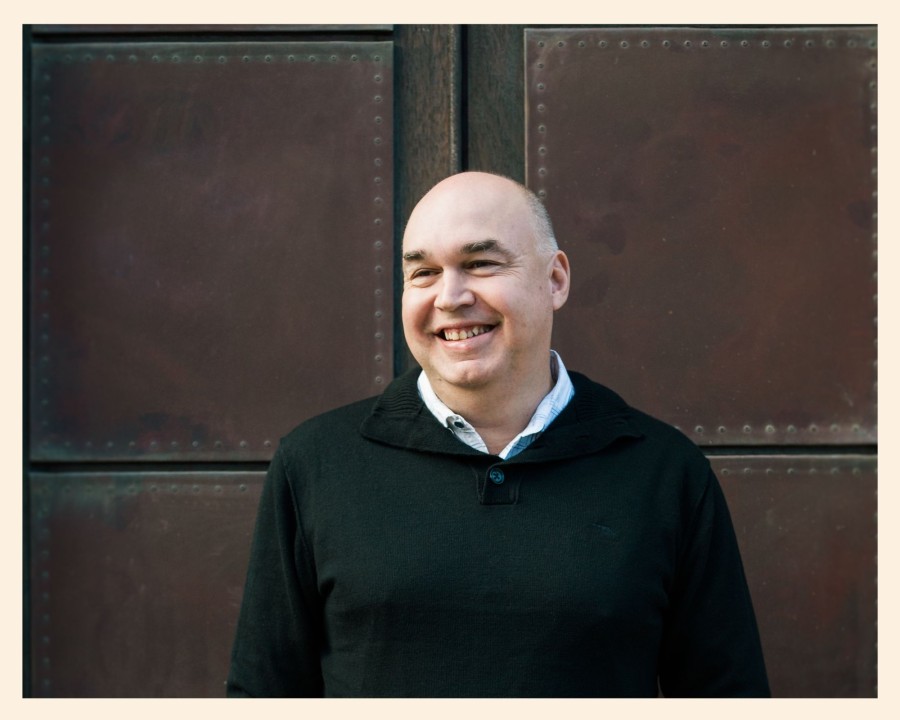
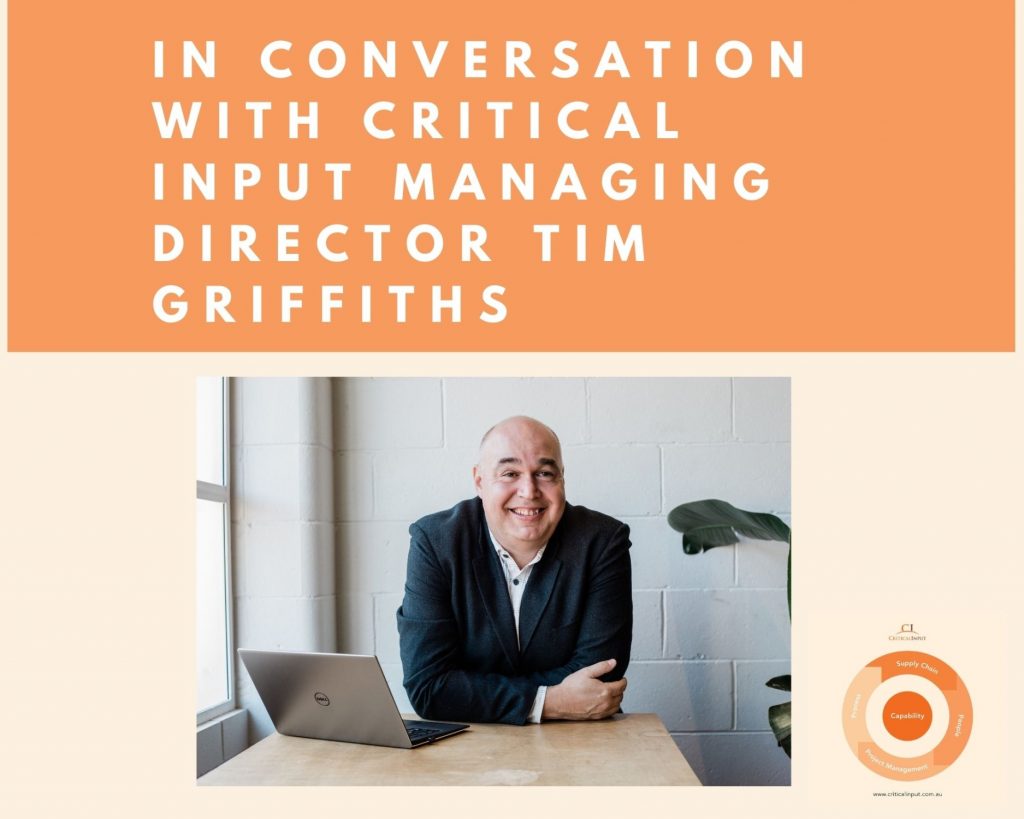
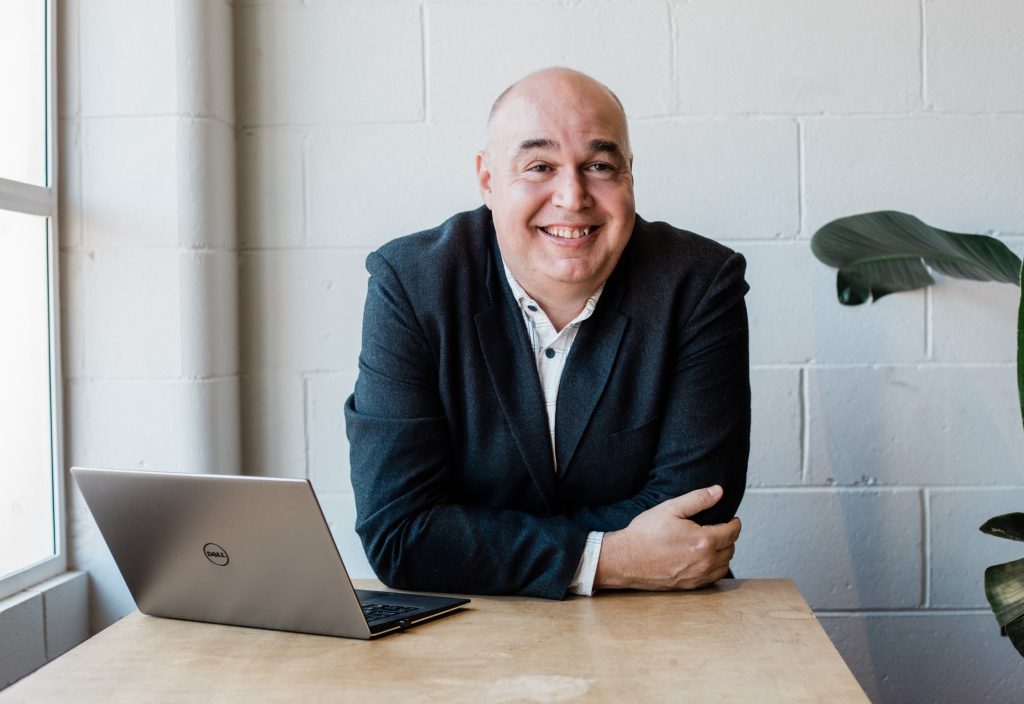
In conversation with Critical Input’s Managing Director Tim Griffiths

A supply chain and procurement specialist, Critical Input Managing Director Tim Griffiths uses transparent processes and pragmatic principles to help organisations run like well oiled machines. Originally from Tasmania but now based in Brisbane, Tim’s all about bringing people and processes together, particularly when it comes to organisational inputs that are deemed critical for optimal function. Tim’s team is spread throughout Australia, including a ‘second headquarters’ in WA. Critical Input’s people work remotely or client-side to complete projects that meet and exceed client objectives. Here he talks about what he’s been working and focussing on lately.
How do you juggle balancing Critical Input as a business, while also undertaking hands-on operational work?

I often get asked this question. Indeed, many of my peers advise me to spend more time “on the business”, rather than “in the business”. There’s merit to this and I take this suggestion seriously (nod to John Edwards), but to ensure Critical Input offers the right services and resources, it’s imperative that all our resources (including myself) have a hands-on operational understanding. So this is why I also jump in and roll up my sleeves from time to time. It’s not about taking works away from our senior resources, but more about filling in gaps on an ad hoc basis when my specific skills can add value or deadlines are tight.

Can you give us some examples of projects where you’ve been “on the tools”?

I’ve recently undertaken supply chain mapping for global logistics company, a procurement/contracts framework review and process re-alignment for a national construction entity and a supply chain review and enhancement for global mining company. All great fun and this work keeps me connected to our client needs, which ensures we maintain a high quality service.

As someone who has a window view into multiple workplaces, what trends have you noticed emerge since Covid-19? Have there been some positives?

Critical Input has always offered agile delivery, but during this past year, I’ve seen organisations quickly pivot to embrace remote activities and in turn discover improvements in productivity. Covid-19 has also shone a new focus on individual welfare. Flexibility within the workplace – including a mixture between working from home and working from the office – is part of that and I see this as very positive.

What is most important to you right now?

Priorities for me right now are a blend of the usual business-related elements like building our future pipeline of activities, as well as delivering quality outcomes for important projects. We often underestimate how much time business owners focus and work on these elements. I’m also very mindful of the wellbeing of CI’s resources as we’re now in the second year of a global pandemic. With team members spread across the country, I’m grateful when borders are open and domestic travel is accessible as it’s great to catch up face-to-face every now and then. 

Any interests that are occupying your time outside of work?

On a side-note, my wife and I own a hobby farm west of Toowoomba in Queensland, which we’ve named TIBENACH Rise. It’s something we enjoy working on during our weekends and holidays, but the end of the drought has meant things are gaining momentum, so watch this space for further announcements!

Australia: the stable supplier of critical minerals

As economies around the world endeavour to recover, Australia’s role as a leading global supplier of critical minerals will only increase. 

According to Managing Director of Critical Input Tim Griffiths, it’s no surprise that Australia’s mining sector kept Australia’s economy mostly rock-solid throughout the pandemic, but now is the time to “get strategic”.

“Australia has managed the Covid-19 pandemic with few interruptions, which has further enhanced our international geopolitical image, so increasingly, other countries will be looking toward Australia to shore up secure supply chains,” Tim said.

“The United States Biden Administration intends to develop renewable energy facilities, smart grids and a robust electric vehicle industry and private companies like Telsa have set ambitious targets.

“These sustainable industries require critical minerals, many of which can be found in Australia.” 

The amounts of lithium, cobalt, graphene, indium and other critical minerals needed for low-carbon technologies alone are expected to increase anywhere from 100 per cent to 1,000 per cent by 2050. (Source: The Conversation)

This accelerated pivot is placing pressure on critical mineral supply chains, which are frequently linked to environmental, social and governance (ESG) risks. 

COVID-19 exposed vulnerabilities associated with concentrated supply chains and many countries are now seeking to manage this exposure by diversifying its supply chains.

“Australia is seen as a reliable supplier with significant potential to supply an array of critical minerals and battery metals,” Tim said.

“As well as having reserves in the ground, Australia’s depth of experience and expertise in mining means it’s seen as a global supplier of choice for ethically sourced critical minerals.

“So while it’s difficult for mining companies to shift gears, trade complexities between Australia and South-East Asian countries as well as a push toward renewables is going to mean increased investment in critical minerals and a move away from coal and gas. Companies willing to pivot will be the ones prepared for the future.”

The three categories of risk every procurement function faces in 2021

By Critical Input Senior Consultant James Brown.

As a consultancy that works with a number of mining, infrastructure and heavy industry organisations, Critical Input has been observing some recurring themes, which we believe every procurement function needs to consider during their post-pandemic reset. The leading challenges can be placed into three categories; governance and risk, digital integration and Supplier Relationship Management (SRM). Some of these conundrums may have always been there, but in the absence of a major global crisis, they’ve quietly laid dormant. Now that Covid-19 has exposed the vulnerable underbellies within supply chains, it’s time to take a closer look and investigate ways to better protect – or even inoculate – against future worst-case scenarios. Let’s look at these key categories and the challenges they present and explore solutions to best address them.

Governance and risk:

It’s always been there, but the past year has highlighted how fragile and unprepared we were for a black swan event such as Covid-19. This risk remains top of mind for procurement teams. Many industries have reviewed the security of supply, but the next step relates to developing an ethical and sustainable supply chain. Good governance of supply chain management now includes ensuring local content, supplier diversity, sustainable practices and low carbon footprints while guarding against modern-day slavery risks. To counteract geopolitical, legislative or logistical risks, many larger organisations are investing in expanding their network of local suppliers. Some of these partnerships are proving successful, while others are falling short of expectations with businesses at a loss on how to further progress.

Digital integration:

The software and technology space has significantly evolved during the past five years. We’re seeing an increased number of dedicated technology solutions addressing procurement issues. But it’s creating clutter and often detracting from the real issue, which is poor processes. For these solutions to integrate with other technologies within the organisation, the solutions are becoming too generic and often do little to enhance procurement efficiency. With technology providers driving the solutions, rather than procurement or business teams, the technology isn’t delivering the promised panacea. This has led to frustration within procurement teams where process issues remain unaddressed.

Collaboration and Supplier Relationship Management (SRM):

Most well established procurement teams are running category management or strategic sourcing events with promising outcomes. But after finishing on a high, findings seem to be filed, never seeing the light of day. The benefits of SRM have been difficult to quantify due to a lack of tangible measurement. After all, when the Chief Financial Officer (CFO) asks for the cost benefits, “good relationships” don’t show on the balance sheet. Yet, without certain components within the supply chain process, some businesses could be wiped out entirely. During Covid-19, organisations that invested in building supplier relationships were able to achieve security of supply that would have otherwise been unattainable. What price do we put on surviving the unimaginable? Given that SRM has the power to make or break a business during a crisis, SRM needs to be formally recognised. Progressive organisations are already moving to factor it in as a standard future way of working, in a similar way in which they might take out an insurance policy.

Where to now?

At Critical Input, our extensive experience in these three key areas, coupled with our Supply Chain Review (SCR) tool that addresses the trio of concerns, can assist in answering the dilemmas these issues create within an organisation.

Critical Input Supply Chain Review (SCR) Service

Now, more than ever, organisations need to understand the status of their supply chain. That’s why Critical Input offers a Supply Chain Review Service. This quick, external review provides valuable data and evidence for improvements or changes.

Critical Input’s Supply Chain Review (SCR) service provides a snapshot of your organisation’s supply chain, its maturity and what improvements may be required.

The qualified and quantified review looks at all elements of your end-to-end supply chain and captures its capability and capacity, then recommends opportunities for improvement if required.

We see the below functions as part of the end-to-end supply chain spectrum:

  • Management
  • Strategy
  • Procurement
  • Purchasing
  • Contracting
  • Contract management
  • Category management
  • Vendor management
  • Demand management (interface with capital and operations)
  • Inventory
  • Master data management
  • Warehousing
  • Logistics

About the author:

Critical Input Senior Consultant James Brown is an accomplished and goal-driven manager with more than 20 years of experience in strategic and tactical business leadership. Based in West Australia, James’ expertise includes managing business process change to achieve maximum results with effective planning and communication as well as a solutions-oriented approach to organisational challenges. Armed with a Bachelor of Commerce and an MBA, James specialises in transformation and capability uplift, particularly within the context of supply chain and procurement in heavy industry.

In conversation with Steph Cush

Senior Consultant with Critical Input Steph Cush joined Critical Input in 2017, bringing her warmth, adaptability and willingness to roll her sleeves up and get the job done. Steph is a great team player who brings a practical approach to her work and thoroughly enjoys developing new connections on each project she works on. Here we catch up with Steph to hear what’s keeping her busy and what’s inspiring her.

What are you currently working on?

I’m working on a project with Sydney Water in the Helix space. It involves building process maps and ensuring alignment with these processes and their training requirements to ensure consistent information will be available to the user. I’m part of a great team within Critical Input, but also connected with some incredibly helpful and friendly Sydney Water people to gain access to information. 

Can you tell us about a piece of work that made you feel proud?

I met some really intelligent, motivated subject matter experts during a project for Coronado Curragh. I love being part of a great team and I felt privileged to learn from these individuals and contribute to the development of this piece of work. 

Is there a colleague you’d like to give recognition to?

My colleague Tom Whiting is a superstar. He has the most natural ability to lead and encourage his teammates and is clear, informative and patient. He’s a true asset to Critical Input.

Have you observed positive (work) outcomes that have come out of Covid?

Technology has been pretty amazing throughout this time – it can be painful at times but overall it’s been hugely positive. It’s amazing how much you can still feel part of a team even when separated by closed borders. 

What is most important to you right now on a more personal level?

I’ve recently moved to Sydney, so developing a new community down here is important to me. This is pushing me out of my comfort zone and encouraging me to say ‘yes’ to new opportunities. 

Meet Critical Input Project Professional Tom Whiting

At CRITICAL INPUT, we only engage people who are experts in their field.
Case in point is our Senior Consultant Tom Whiting, who as well as being an impressive project lead, is also highly credentialed within the sustainable energy space.

Added to that, Tom was the first Aussie (to our knowledge) to become an accredited NEC4 Engineering and Construction Contract (ECC) Project Manager.

And bonus, he’s brilliant at stakeholder management and a pleasure to work alongside.

“I have a comprehensive understanding of project and portfolio management (certified PMP), specialising in large infrastructure and resource projects. My approach to project/program management is to use a consistent approach but make innovative steps, foster knowledge transferring and a ‘continuous improvement’ culture. These are the principles that I’ve adopted throughout my career and education.” – Tom Whiting, Senior Consultant, Critical Input

Tom is a master of internal and external stakeholder engagement.

He’s worked as a project professional in Australia and overseas for 15 years.

His background in global energy, coupled with his experience in the emerging alternative energy sector, have made him an expert when it comes to planning, sourcing and executing multi-billion-dollar projects in rapidly changing industries with challenging environments.

Tom is a firm believer that people, not balance sheets, build projects and that success comes from having the right team and tools for the job.

Tom holds an MBA from Durham Business School and is a Project Management Institute-certified Project Management Professional.