
When program transformation falls flat

When Transformation Falls Flat: The Textbook Does Not Always Survive the Real World

When program transformation falls flat

When Transformation Falls Flat: The Textbook Does Not Always Survive the Real World


Again and again, we see the same thing.

A large organisation engages a major consultancy firm. The review looks impressive. The slide deck is polished. The recommendations are logical, well-structured and often technically correct.

Then implementation starts.

And that’s often where we see the wheel start to wobble.

It’s not that the strategy is always wrong, but it has often been developed through a textbook lens, not through the practical reality of how the organisation actually works day-to-day.

At Critical Input, we see this regularly across procurement, supply chain, contracts, project delivery and operational improvement.

The issue is rarely the report itself – it’s turning the report into something people can actually apply.

The Problem With “Consulting Theatre”

There is nothing wrong with strategy, operating models, maturity assessments, frameworks and roadmaps.

They all have their place.

But if a roadmap does not survive contact with the business, it’s just a nice-looking wish list.

Too often, recommendations assume:

  • clean data;
  • aligned stakeholders;
  • good systems;
  • available resources;
  • clear governance;
  • plenty of appetite for change.

Nice in theory.

A bit different on a wet Tuesday when the procurement team is stretched, project teams need answers yesterday, systems are clunky, suppliers are under pressure and operations are trying to keep the wheels turning.

That is where transformation gets hard.

And that is where it actually matters.

Practicality Cannot Be an Afterthought

Most improvement programs do not fail because the organisation missed the problem.

They fail because the solution is not practical enough to implement.

Common issues include:

  • operating models that do not reflect real decision pathways;
  • process maps that ignore workarounds and handoffs;
  • procurement frameworks that exceed available capability;
  • category strategies that assume market leverage that is not there;
  • governance models that create more meetings, not better decisions;
  • system uplifts that automate poor process;
  • savings targets that are not grounded in supplier behaviour or delivery reality.

In plain English: the theory might be right, but the execution model is wrong.

Critical Input’s Difference

Critical Input was built around a simple view: Improvement only matters if it can be implemented.

Our work sits across process, people and principles.

We do not just diagnose the problem and leave the client with a report to wrestle with.

We get into the details – procurement, contracts, supply chain, logistics, project delivery, governance, reporting, commercial controls and stakeholder behaviour.

Then we help shape solutions that are practical, staged and owned by the business.

It’s not consultant-owned, but business-owned.

And that’s what makes all the difference.

Business-owned processes make all the difference

The Best Recommendation Is the One People Can Actually Use

A good improvement program needs to answer four basic questions:

  1. What needs to change?
  2. Why does it need to change?
  3. Who owns it?
  4. How will it actually work?

That fourth question is where many programs fall short.

At CI, we spend a lot of time on the “how”.

  • How will this work on Monday morning?
  • How will procurement, operations, finance, legal and project teams use it?
  • How will suppliers respond?
  • How will progress be measured?
  • How will it be embedded without creating another layer of bureaucracy?

That is the hard graft.

No shiny lanyard required.

Experience Matters When the Work Gets Messy

Transformation is not just about methodology. It’s about judgement.

And judgement comes from being inside live projects, constrained markets, complex contracts, stretched teams, ageing systems, shutdown environments and operational businesses where decisions have real consequences.

CI’s people are senior practitioners. We have worked in the environments we advise on.

We know a procurement strategy has to survive the market.

We know a contract management framework only works if project teams actually use it.

We know supply chain risk is not fixed by a heat map alone. It needs early visibility, clear ownership, escalation triggers and active intervention.

And we know process improvement is not about creating more process.

It is about creating the right process – simple enough to use, strong enough to govern and practical enough to last.

The Bottom Line

Transformation fails when it stays as an intellectual exercise.

Improvement succeeds when it is practical, owned, sequenced and embedded.

That is where Critical Input offers a different approach.

We bring senior, real-world practitioners who can move from diagnosis to delivery – and who understand that the best strategy is the one the business can actually execute.

Because in the end, transformation is not proven in the board pack.

It is proven in implementation.
Construction productivity just got a geopolitical upgrade

Construction productivity just got a geopolitical upgrade

Construction productivity just got a geopolitical upgrade

Construction productivity just got a geopolitical upgrade


Australia’s construction productivity challenge was already a deliverability problem: fragmented demand signals, long-lead exposure, logistics “outside the fence”, and workforce capacity assumed as headcount.

The war in the Middle East turns that dial up again.

When key maritime corridors get disrupted, the impacts land straight on Australian projects, higher energy input costs, war-risk insurance cancellations / premium spikes, and shipping diversions that add time and volatility back into already tight schedules.

Recent reporting has flagged severe disruption risk around the Strait of Hormuz (a critical global energy corridor) and knock-on effects including rerouting and capacity constraints in shipping markets. The Red Sea picture may improve for periods, but the core issue remains – route certainty is conditional.

Here’s the blunt takeaway – geopolitics doesn’t care about your contract boundaries.

If your program is still running supply chain, logistics, and workforce in silos, the next external shock will show up as “productivity” losses on site (rework, resequencing, downtime, expediting, claims – pick your poison).

How CI helps lift productivity (practically)

Improving productivity in this environment isn’t about working harder on site: it requires integrating what sits around it. At Critical Input, we focus on four levers:

– Program Supply Chain Management (PSCM) – one demand signal across packages, long-lead register, capacity locks, supplier assurance and expediting.

– Program Logistics Management (PLM) – “logistics proof plan” (routes, permits, windows), scenario routing, laydown strategy, shipment governance.

– Workforce capacity as throughput – time-to-competence, supervision constraints, roster/IR realities, work front sequencing.

– Early-warning cadence – weekly leading indicators that trigger decisions before the critical path is hit.

A quick test

If you can’t answer these questions quickly, your program is exposed:

  1. One demand signal for critical materials?
  2. What’s truly long-lead and have we locked capacity?
  3. What’s our logistics proof plan?
  4. Is workforce modelled as time-to-competence?
  5. Where are the top interface risks?
  6. What are our weekly early warnings?

Productivity is now a system problem

The definition of construction productivity is shifting.

It’s no longer just what happens on site, it’s how well the entire system anticipates and absorbs disruption, especially in the state of supply chain today.

Because the next shock isn’t a hypothetical anymore, it’s already in motion.

If these risks are showing up in your program, now’s the time to address them. Reach out to Critical Input to see how an integrated approach can drive sustainable, resilient delivery performance.

Supply Chain - Deliverability by Design

Supply Chain: Deliverability by Design

Supply Chain - Deliverability by Design

Supply Chain: Deliverability by Design


Delivering major programs in Australia is no longer a linear procurement exercise. Schedule certainty is won, or lost, across four (4) interdependent constraints:

  1. Program-level supply chain integration,
  2. Global sourcing and capacity security,
  3. Logistics deliverability across real corridors and approvals, and
  4. Workforce capacity based on throughput and time-to-competence, not headcount alone.

Managed in silos, contract boundaries create competing demand signals, logistics constraints emerge “outside the fence” and workforce ramps fail on optimistic assumptions.

When governed as one system, the program achieves a single demand signal, realistic commitments, validated movement windows, and an early-warning cadence that protects the critical path – ensuring programs remain deliverable by design.

Why do programs lose certainty?

Despite strong planning and capable contractors, many major programs still lose schedule certainty. The causes are rarely isolated events, emerging when supply, logistics and workforce planning evolve separately instead of as one integrated system.

  • Supply risk is fragmented across contractor packages, creating competing demand signals to the same constrained supplier market
  • The market does not respect contract boundaries: long-lead equipment and sub-tier constraints sit on the program critical path
  • Logistics constraints often sit outside the fence (think: roads, bridges, rail, ports, permits, community windows) and become critical path drivers if not validated early
  • In a tight market, people are a long-lead item; workforce capacity is shaped by program design (sequencing, mobilisation throughput, supervision, time-to-competence and accommodation), not recruitment effort alone

The deliverability stack (integrate as one system)

Programs that maintain certainty treat these constraints as a single system. When supply chain, procurement, logistics and workforce planning are integrated at the program level, risks surface earlier and decisions are made with full visibility of downstream impacts.

  • Program Supply Chain Management (PSCM): Owner-led operating model that establishes a single demand signal, determines principal-supplied versus contractor-supplied items, and runs integrated reporting – with the procurement status view treated as the controlling record
  • Global procurement (program discipline): Aggregates demand, secures critical manufacturing capacity early (slots/sub-tier), and embeds quality, inspection and logistics requirements into the sourcing approach – not as an afterthought
  • Program Logistics Study (PLS): Program-level deliverability proof that validates movement of critical items from EM/port to site, with corridor constraints, permits and infrastructure upgrades embedded into schedule and governance
  • Workforce planning (capacity design): Time-phased role-family demand model validated against market reality; one constraint matrix across supply, logistics, workforce and IR, governed through latest responsible decision dates (LRDDs) and weekly early warning indicators (EWIs).

Boat at port dock loading supply for chain

Before award: what executives should insist on

Supply chain deliverability is largely determined before contracts are even signed. Executives who want to protect program schedules must ensure key supply, logistics and workforce assumptions are tested, validated and embedded before award. Here’s what to consider:

  • An explicit principal-supplied versus contractor-supplied decision for long-lead / schedule-critical items, with contractors retaining accountability for installation, integration and performance.
  • Route surveys and corridor verification completed for each critical movement; OSOM access decisions and permit lead times are incorporated into the master schedule.
  • Infrastructure upgrades (temporary and permanent) are defined, funded, sequenced and assigned with clear accountability (owner versus contractor).
  • A global sourcing plan that demonstrates how capacity is secured and how inspection, QA, storage/quarantine and logistics interfaces will be governed end-to-end.
  • Workforce ramp assumptions anchored to an outside view; mobilisation throughput, supervision ratios and time-to-competence are modelled; accommodation/transport constraints are tested
  • A weekly deliverability cadence: one constraint matrix with LRDDs, owners and trigger actions; EWIs tracked so issues surface early, before milestones slip.

From complexity to certainty: designing deliverable programs

Major programs succeed when delivery constraints are treated as a single operating system, not separate disciplines.

Integrating supply chain strategy, global sourcing, logistics deliverability and workforce capacity planning creates one demand signal, one constraint view and one decision cadence – allowing risks to surface early and be addressed before they impact the critical path.

At Critical Input, this integrated approach underpins how we support major infrastructure and resources programs. Our focus is simple: helping owners design delivery models that reflect real market capacity, real logistics corridors and real workforce constraints.

The result is stronger schedule certainty, clearer accountability, and programs that remain deliverable from planning through to execution.

It’s all about ensuring processes aren’t just refined but adaptable and aligned with strategic objectives, offering a holistic approach to business excellence.

Interested in strengthening your deliverability stack? Explore our in-depth guides on program supply chains, logistics deliverability, workforce planning and more here.

Workforce Planning: Building Capacity That Survives Reality

Workforce Planning: Building Capacity That Survives Reality

Workforce Planning: Building Capacity That Survives Reality

Workforce Planning: Building Capacity That Survives Reality


Capacity is not a resourcing problem; it’s a design problem.

In Australia’s current delivery boom, people are the long-lead item. When labour is tight, recruiting harder does not create capacity; it just increases churn and wage pressure.

When it comes to workforce planning, real capacity is shaped by program design: packaging, sequencing, mobilisation throughput, accommodation, and the industry settings you choose to operate under.

Why workforce plans blow up

When programs fall behind on workforce, the blame often goes to things like skill shortages or market constraints. However, the real cause sits upstream: flawed assumptions embedded in the baseline.

Common failures:

  • Inside-view optimisation becomes the baseline plan (best-case ramps dressed up as “realistic”)
  • Uniqueness bias: “we’re different” – which is usually code for “we’re not checking comparable outcomes”
  • Base-rate neglect: no disciplined comparison to what similar programs actually achieved
  • Strategic misrepresentation: convenient assumptions survive governance until site reality arrives

The 5-step capacity method that survives procurement and reality:

Step 1: Outside view first

Anchor ramp-up, lead times, and productivity to reference class outcomes.

Any claim above base rate stays a risk until it is evidenced.

Step 2: Build a time-phased demand model from the work

Model packages and role families by geography, including supervision and time-to-competence.

Run base / constrained / accelerated scenarios so the trade-offs are explicit.

Step 3: Validate the market without contaminating procurement

Use controlled, staged engagement: scripted, logged, and de-identified by default.

Test capacity claims against commitments, throughput limits, credentials and onboarding constraints.

Step 4: Convert constraints into decisions

Maintain a single constraint matrix across supply, workforce, logistics and IR.

Set latest responsible decision dates (LRDDs), options, and trigger actions before options collapse. The reality is: if you wait for certainty, you’ve already lost optionality.

Step 5: Build early warning into the operating rhythm

Confidence-grade critical assumptions and monitor early warning indications (EWIs) in a weekly pulse.

Escalate on leading indicators, not after the milestone slips.

Build early warning into the operating rhythm

4 ways to break the capacity ceiling:

1)     Shape demand before you chase supply

Rather than theoretical competition: smooth peaks, resequencing work, and package for real market depth. Use backwards-pass logic from required-on-site dates to protect long-lead procurement and mobilisation windows.

2)     Build throughput, not just headcount

Mobilisation is a phase, not a date. Increase induction, access, clearance and supervision throughput so labour can land and be productive.

Fix logistics and interface friction – wasted hours are negative capacity.

3)     Shorten time-to-competence with deliberate pipelines

Most programs underestimate how long it takes for people to become useful.

Activate training partners early and link intake timing to your demand curve (not funding cycles). Use mentoring and supervisor uplift to boost competence without breaking safety or quality.

4)     Engineer continuity: absorptive capacity + IR stability

You can’t FIFO your way out of a housing shortage – you move it into the schedule.

Test accommodation, transport and local services as real constraints on ramp rate and retention in regional locations. Set site standards, dispute pathways and leading indicators (absenteeism, fatigue, grievances) – and intervene early.

Critical Input: designing real capacity in a tight labour market

At Critical Input, our priority is holistic, sustainable solutions, integrating people, process and principles to enhance business processes from start to finish. We understand the complexity of workforce planning, which is why we’re equipped to:

  • Build the demand model and constraint matrix (role family taxonomy, scenario curves, time-to-competence realism)
  • Run probity-safe market and workforce validation to separate capability statements from deliverable capacity
  • Design packaging and commercial settings that match market reality (competition, risk allocation, incentives)
  • Develop workforce and mobilisation strategy (sourcing mix, pipeline partnerships, retention and accommodation plan)
  • Stand up the early warning dashboard and governance cadence, including decision briefs with LRDDs.

If you can’t say what decision must be made by when to avoid a capacity-driven delay, you don’t have a workforce plan – you have a hope-and-pray schedule. In Australia’s delivery boom, that’s a governance risk.

Want sustainable workforce capacity for your organisation? Reach out today.

Global Procurement for Mega Projects

Global Procurement for Mega Projects

Global Procurement for Mega Projects

Global Procurement for Mega Projects

Why Southeast Asia belongs on Australian program’s sourcing map


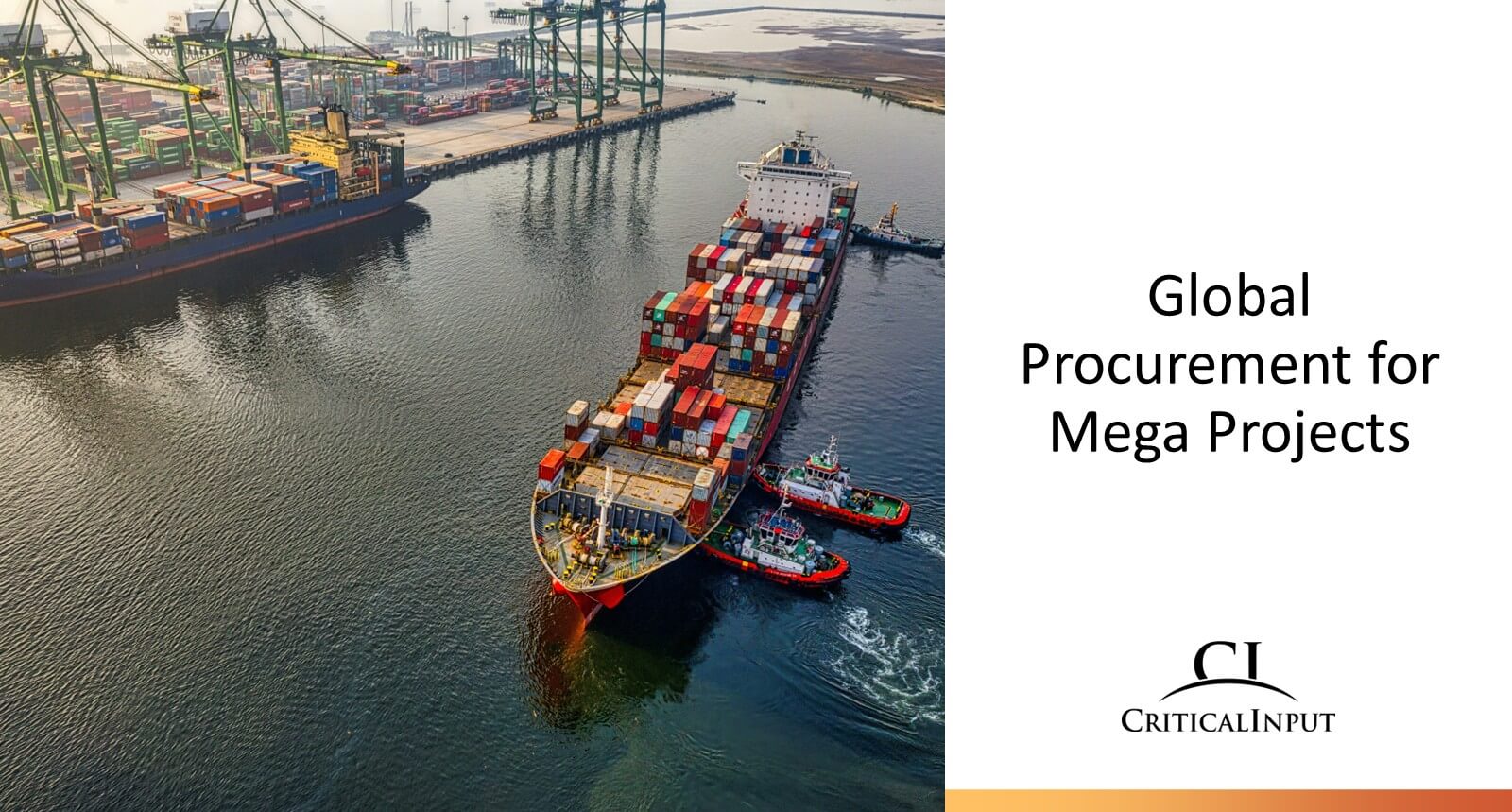
If you’re delivering a mega project/program in Australia and the procurement plan is to let the EPCs sort it out, you’re betting the schedule on the market being kind.

Right now, the constraint is rarely your tender process. It’s manufacturing slots, supplier capacity, and the logistics/QA system wrapped around it. We see it in constrained equipment markets where lead times stretch, and supplier pools are thin.

That’s why global procurement, done properly, is becoming a program delivery discipline as opposed to a procurement side quest.

What global procurement means for programs

Global procurement isn’t buying offshore, it’s a program-level sourcing model that:

  • Aggregates demand across packages – one demand signal, not ten
  • Locks critical capacity early – slots, sub-tier materials, long-lead components
  • Hardwires quality, inspection and logistics into the plan – not after the award
  • Deliberately decides what is principle-supplied versus contractor-supplied

If you don’t design it, you’ll get the default fragmented buying, duplicated expediting, and contractors competing in the same OEM queue.

Why Southeast Asia is a streamlined option for Australian programs

1) Trade frameworks reduce friction (if used properly)

Australia has established regional trade frameworks including AANZFTA and RCEP, supporting market access and tariff preferences when rules of origin and documentation are handled properly.

2) Manufacturing ecosystems that match common project categories

Southeast Asia isn’t one market, but it does have depth in specific categories that repeatedly show up in Australian programs, especially electrical/electronics and industrial manufacturing supply chains.

  • Malaysia – mature electrical & electronics base
  • Thailand – strong E&E sector and export orientation
  • Vietnam- electronics exports are significant and growing
  • Philippines- electronics exports are a major share of merchandise exports, with semiconductors a key contributor

3) Logistics optionality via major hubs

Logistics shouldn’t be an afterthought for global procurement: it’s a design input. Singapore remains a major transshipment hub (around 90% of container throughput tranship onwards), which can improve routing and consolidation options.

container yard aerial

Where Southeast Asia fits, and where it doesn’t

Best-fit (often) for Australian programs:

  • LV/MV switchboards, control panels, PLC/SCADA cabinets (tight specs plus FAT plus third-party inspection)
  • Modular skids / packaged plant (standardise, test, ship as modules)
  • Selected fabrication and assemblies (where code compliance and QA are enforceable)

This isn’t theoretical. We’ve recommended actively exploring SE Asian factory options in electrical categories to shorten lead times, as opposed to limiting options to legacy-approved lists.

Be cautious/selective when:

  • Safety-critical bespoke rotating equipment without strong OEM backing and local support
  • Ultra-high voltage primary plant where compliance/prequalification constraints are hard gates
  • Any category where you can’t practically enforce inspection, traceability, and documentation

Rule of thumb: SE Asia can be excellent if you control the system (specs + QA + logistics + warranty), not just the purchase order.

Southeast Asia sourcing map

  • Malaysia / Thailand – strong base for E&E manufacturing ecosystems (useful for panels/controls/selected assemblies)
  • Vietnam – large electronics export sector; good for electronic assemblies and supply chain options
  • Philippines – electronics/semiconductor ecosystem is economically significant; relevant for electronics supply chains
  • Indonesia – can be relevant for fabrication/industrial supply, but capability varies by region and supplier, you must be disciplined on QA and logistics

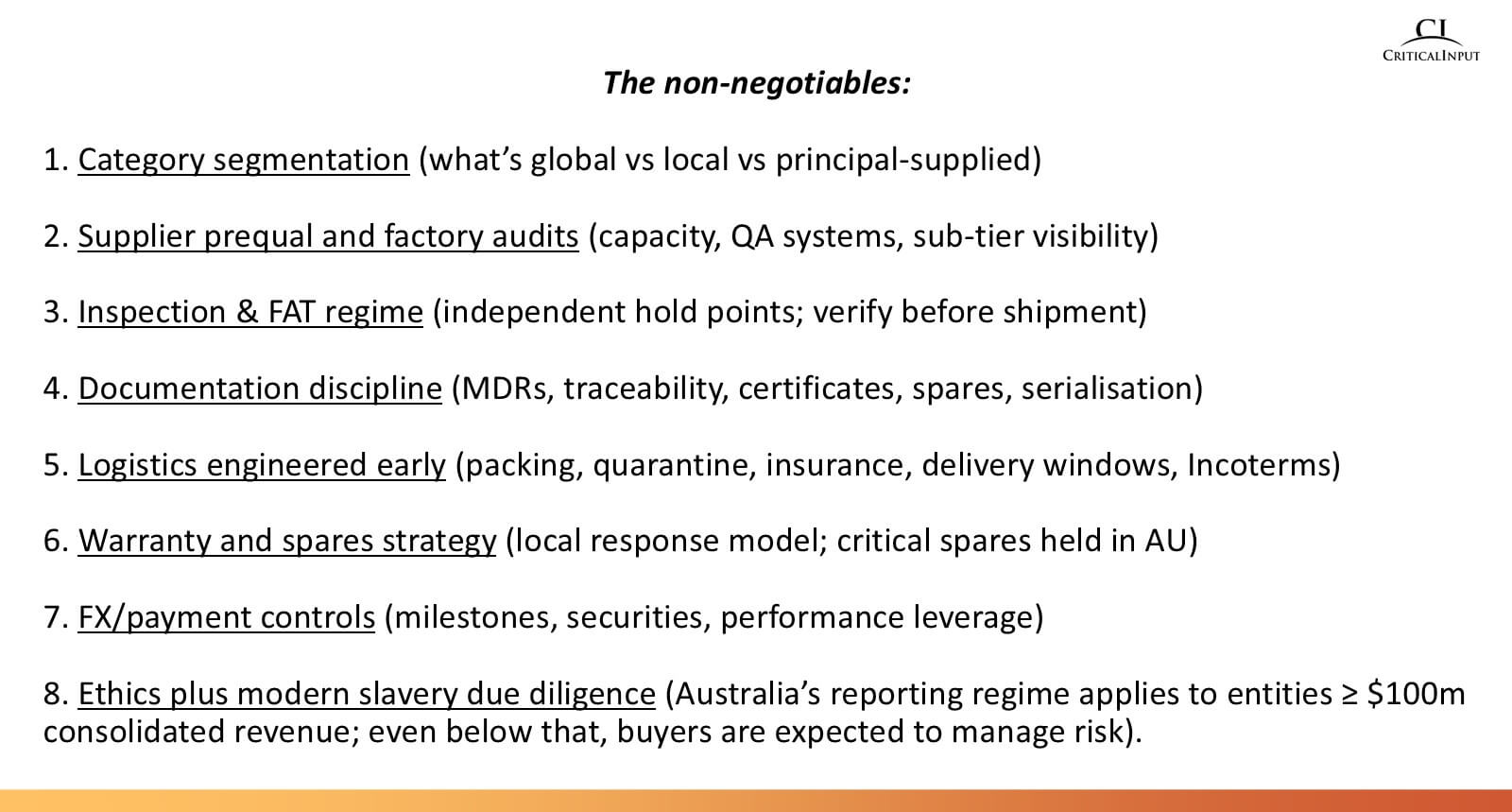
The non-negotiables – how to de-risk SE Asia procurement

If you want program certainty, these are the table stakes:

The non-negotiables (how to de-risk SE Asia procurement)

A smart global procurement strategy doesn’t replace contractors; it makes the program deliverable.

Used well, Southeast Asia is part of a diversified sourcing map that can improve lead times, increase capacity options, and reduce surprise logistics/quality failures – especially when the alternative is everyone queuing at the same OEMs and hoping for the best.

Want strategic procurement that elevates every link of the chain? Reach out to Critical Input today.