Program Logistics Studies: The Aussie reality check for major projects

Program Logistics Studies: The Aussie reality check for major projects
Program Logistics Studies: The Aussie reality check for major projects

Program Logistics Studies: The Aussie reality check for major projects


Most logistics planning on big projects is really site logistics – laydown, cranage, gates, traffic controllers, and a mud-map that gets rewritten after the first truck meets the first roundabout. 

It’s necessary, but it’s not enough.  

In Australia, the schedule killers usually sit outside the fence, on public roads, bridges, rail corridors, ports, and in community and approvals pathways that don’t care what your contract says. 

If your program relies on heavy, oversized, high-value equipment (think transformers, switchgear, pumps, pressure pipe, treatment process packages, rotating plant), you need a Program Logistics Study early.  

And you need it tied into program controls, procurement and approvals for streamlined success.  

Why this matters in Australia? 

Long distances and thin corridors – a lot of work is regional. You’re dealing with: 

  • Long haul routes through towns, floodways’ and single-lane bridges 
  • Limited alternatives (one road in, and one road out) 
  • Seasonal closures and weather events that make float disappear fast 

Bridge and road limitations are real (and common) – the big stuff is an infrastructure problem, not just a truck problem: 

  • Bridge ratings and axle loads 
  • Swept paths through intersections/roundabouts 
  • Overhead clearances and utilities 
  • Pavement capacity (especially on regional roads) 

You don’t want to discover the constraint after the OEM has built the item and it’s sitting at a port accruing storage 

OSOM access is a regulated pathway, not admin – oversize moves require planning across: 

  • NVHR access decisions (where applicable) 
  • State/territory road managers 
  • Councils, police escorts, traffic control approvals  
  • Route assessments and conditions that can change 

It’s a workflow with lead times and it belongs in the master schedule.  

Rail and ports are capacity systems (with windows, not wishes) – if you’re using rail or ports, you’re competing with: 

  • Planned works, possession windows, curfews 
  • Limited cranage/laydown capacity 
  • Quarantine, inspection, handling constraints 
  • Industrial relations and access rules 

Community impact is not soft, it’s permission to operation – in Australia, abnormal load convoys and high-frequency haulage hit: 

  • School zones, local business access, emergency services routes 
  • Noise restrictions (night moves), road closures, detours 
  • Stakeholder tolerance (and therefore, political tolerance) 

If you don’t manage it in logistics, you’ll manage it later, under pressure. 

What a Program Logistics Study should cover (tighter + practical) 

A proper study is a deliverability proof, not a report. At minimum it should produce these eight outputs: 

1. Critical Movements Register 

What is moving (dimensions/weights/handling/storage), when it must move, risk rating, and who owns it. 

2. Mode & Corridor Strategy (road/rail/sea/intermodal) 

Preferred corridors + alternates, with constraints mapped and verified. 

3. Route Surveys and Engineering Checks 

Bridge assessments, swept paths, clearances, holding yards, turning points, and re-validation triggers. 

4. Access & Permits Plan (OSOM) 

Approval pathways, lead times, dependencies, escorts, traffic control requirements, conditions. 

5. Infrastructure Upgrade Plan 

Temporary/permanent works required (bridge strengthening, intersection mods, pavement upgrades), funding and delivery responsibility. 

6. Port/Rail Interface Plan (if relevant) 

Handling, cranage, laydown, quarantine, possession windows, bookings, and contingencies. 

7. Community & Stakeholder Impact Plan 

Notifications, mitigation measures, school/emergency services interfaces, local access commitments. 

8. Logistics Governance and Reporting 

RACI, a permits/register, a logistics risk register, and a logistics readiness dashboard that links to schedule risk. 

The biggest Aussie trap? Logistics not integrated to procurement + schedule 

A recurring failure pattern is: 

  • Procurement commits to delivery dates, 
  • engineering finalises weights/dimensions late, 
  • logistics starts “after award,” 
  • route constraints surface, 
  • approvals and/or upgrades take months, 
  • the program pays in delay + acceleration + claims. 

It’s all avoidable if logistics is treated as a program control discipline from day one. 

If you want certainty, don’t ask “Do we have a logistics plan?” 

Instead, here’s what to insist on: 

  • Has the route been surveyed and verified for each critical item? 
  • Do we have OSOM access decisions and permit lead times in the schedule? 
  • Are required road/bridge upgrades defined, funded, and sequenced? 
  • Do we have community/stakeholder impacts mapped and managed? 
  • Is logistics readiness reported like cost and schedule, weekly, with actions? 

If the answer is “we’re working on it,” you’re already too late. 

Program Logistics Studies: proving deliverability early (before it all falls apart) 

In Australia, most program logistics is a network problem – roads, bridges, rail, ports, and people – not a site problem. A Program Logistics Study is how you prove deliverability early, protect the critical path, and stop simple transport turning into a six-month surprise.  

If you’re interested in exploring the benefits of Critical Input’s Program Logistics Study, get in contact with us today.  
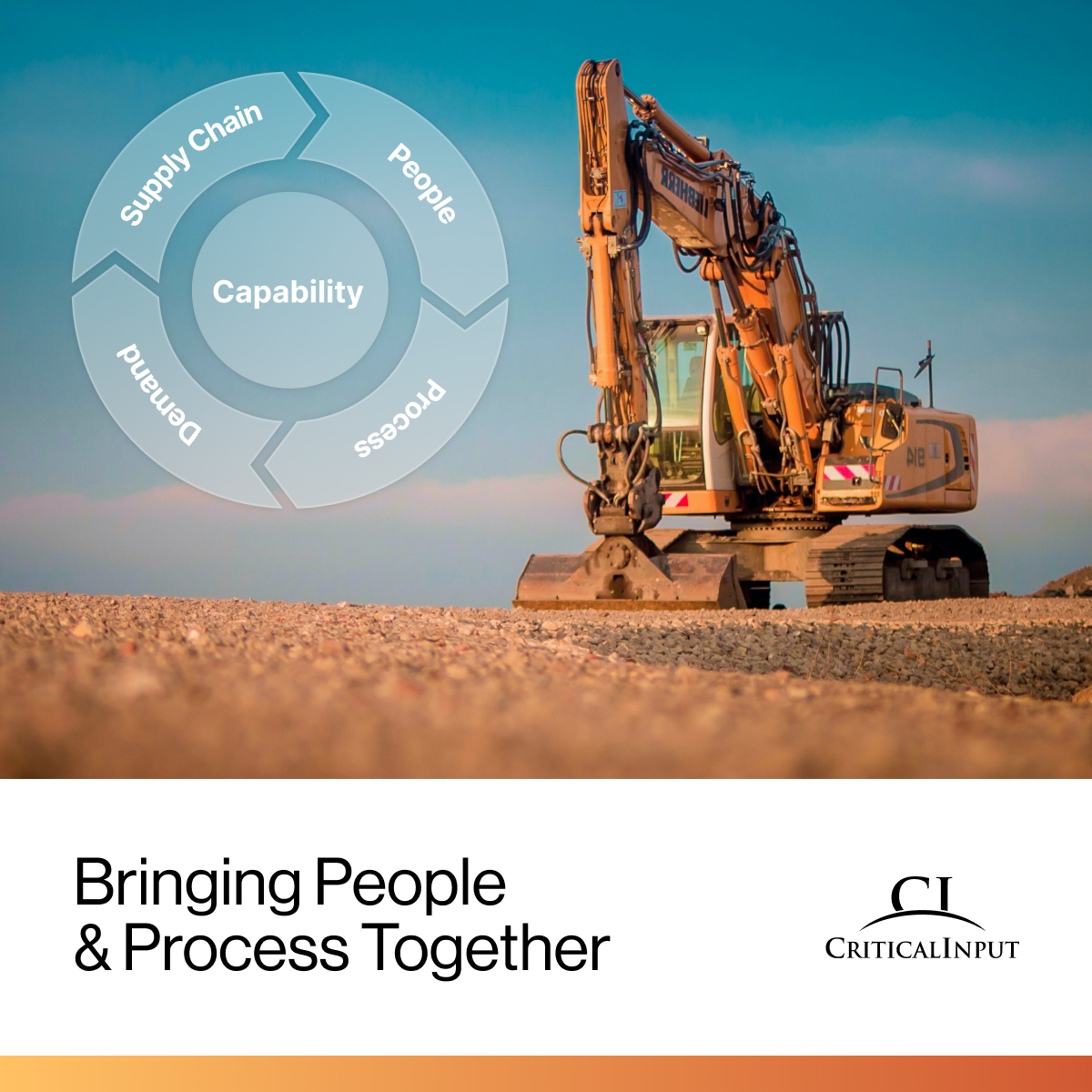
Critical Input: Bringing People and Process Together

Program Supply Chain Management

Program Supply Chain Management

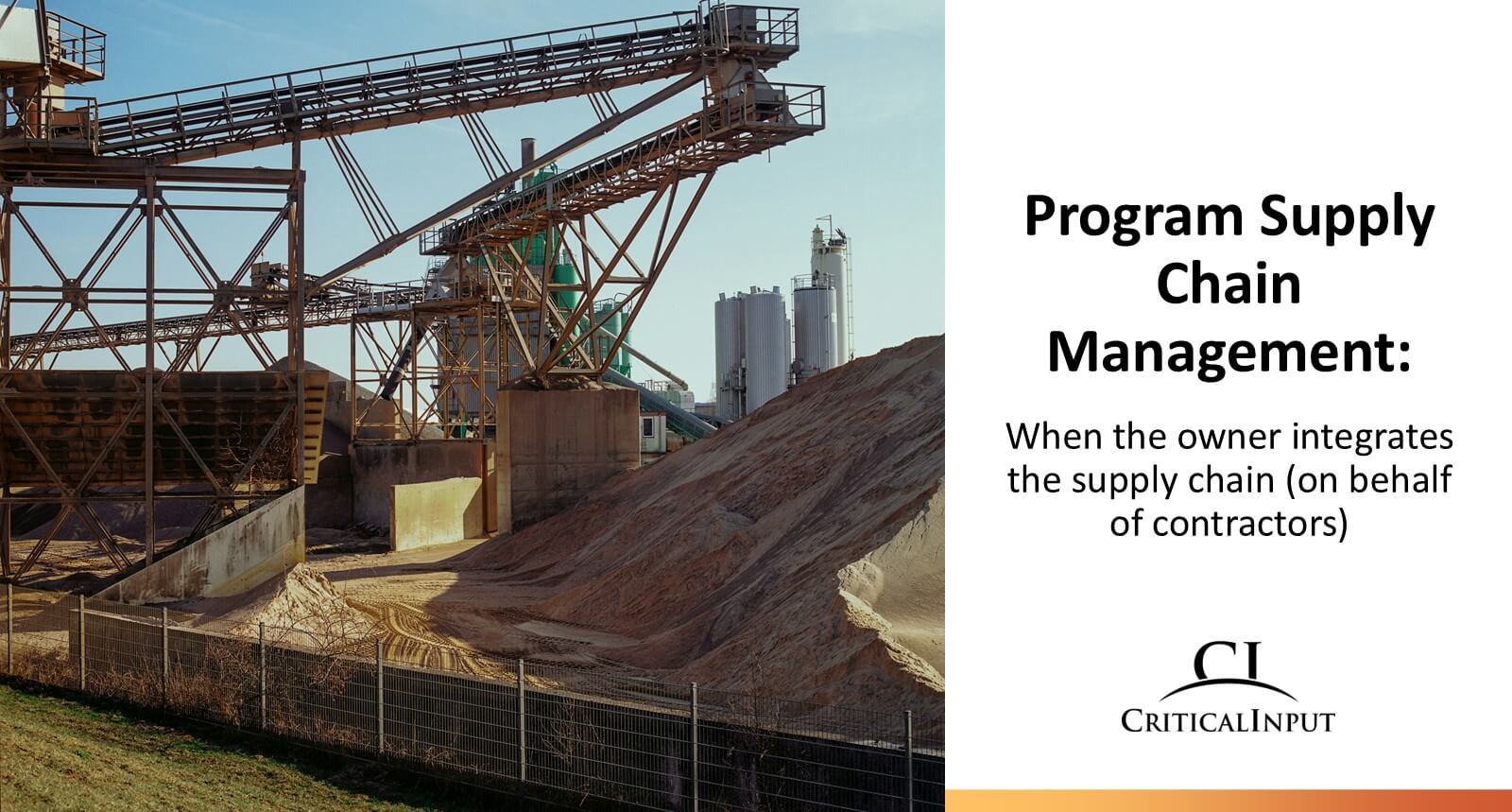
Program Supply Chain Management When the owner integrates the supply chain (on behalf of contractors)

Program Supply Chain Management

When the owner integrates the supply chain (on behalf of contractors)


If you’re running a major project and you’re still leaving every critical material decision to each individual contractor package, you’re probably accepting avoidable schedule and cost risk. The market doesn’t care about your contract boundaries.

Transformers, switchgear, pumps, values, SCADA component, specialist mechanical equipment, treatment process packages, even simple materials with constrained suppliers – they all sit on the program critical path. Yet they’re often procured in fragmented ways across multiple delivery partners.

That’s where Program Supply Chain Management (PSCM) comes in.

PSCM is an owner-led model where the asset owner (or program authority) integrates the supply chain across the whole program and, when appropriate, procures and manages principal-supplied items/materials on behalf of contractors – all while still holding contractors accountable for installation, integration, and performance.

What PSCM is (and what it isn’t)

PSCM is:

  • A program-level supply chain operating model (not just procurement).
  • An approach that creates one demand signal to the market (not three or ten).
  • A way to remove long-lead supply risk from individual contractor packages when it’s smarter for the principal to hold that risk.
  • A mechanism to standardise, leverage buying power, and improve transparency, without crushing delivery partner autonomy.
  • A practical framework for Principal Supplied Items (what the owner should supply vs what the contractor should supply).

PSCM is not:

  • The owner doing the contractor’s job.
  • Centralised procurement for everything.
  • A silver bullet that replaces good engineering, project controls, or site execution.

Why owners are leaning into principal-supplied items

There are a few reasons this model is showing up more often in major programs:

1) Long-lead risk is now a program risk

Long lead times, manufacturing slot constraints, and global shortages mean the commercially neat contract boundary is rarely the operationally sensible boundary.

2) Multiple contractors can unintentionally bid up your own market

Three delivery partners chasing the same OEM capacity is a great way to:

  • lose leverage,
  • lose schedule certainty, and
  • create competing expediting priorities.

3) Standardisation creates compounding benefits

When you standardise key materials/specs, you get better:

  • maintainability,
  • spares strategy,
  • training and competence,
  • asset data quality, and
  • lifecycle cost outcomes.

What “owner-integrated supply chain” looks like in practice

In PSCM, the owner establishes a Program Supply Chain Office (or similar) to sit alongside Program Controls. The office typically owns:

  • Demand aggregation & forecasting (linked to the master schedule and cost baseline)
  • Contracting strategy & packaging (what’s principal supplied vs contractor supplied)
  • Framework agreements / shared purchasing (so delivery partners can buy consistently and quickly)
  • Supplier relationship management (including capacity planning and slot reservation)
  • Expediting, logistics & quality assurance (route surveys, inspection regimes, storage/handling strategy)
  • Integrated reporting and governance (a program Procurement Status Report becomes “the bible”)

This “integrate and enable” posture aligns naturally with collaborative delivery models and contracting suites that promote proactive management and collaboration (for example, NEC’s approach to collaborative contracting).

In PSCM, the owner establishes a Program Supply Chain Office (or similar) to sit alongside Program Controls.

Where Critical Input has seen this work (and why)

Critical Input’s experience across utilities and major infrastructure recognises that owner-led supply chain integration succeeds when it’s treated as an operating model as opposed to a procurement “initiative”.

  • In a major water utility, we supported practical enablers across process, people, project management and supply chain – including integrated project management processes aligned to the delivery model, management operating systems, contractor operating manuals, and the development of a Supply Chain Shared Purchasing function/process/manual that enabled consistent purchasing across delivery partners.
  • In constrained equipment markets, we’ve supported principals to take a more deliberate approach to supply risk – including early market engagement, resilience planning, and deliberate strategies to secure supply capacity.
  • This matters most in major equipment categories and complex assets where supplier markets are constrained and delivery windows are measured in years, not months.

Designing PSCM: what should the owner supply?

A pragmatic way to decide what the owner should supply is to ask:

Should the owner hold this risk?

Owner-led supply is often justified when the item is:

  • long-lead and schedule-critical
  • constrained by limited suppliers / manufacturing slots
  • highly standardised across the program
  • high consequence of failure (safety, compliance, operability)
  • better leveraged as aggregated demand

Contractors should generally retain ownership where:

  • performance depends heavily on their means/methods,
  • supplier choice is integral to their design responsibility,
  • the item is not supply constrained and is easily substituted.

The 7 building blocks to implement PSCM (without chaos)

  1. Scope & boundaries: define principal-supplied items and interfaces (who does what, where, and when).
  2. Demand planning: create one integrated demand signal tied to program controls.
  3. Market & category strategy: package scopes to suit market capacity (and avoid self-competition).
  4. Contracting model: frameworks, direct supply, shared purchasing, incentive alignment.
  5. Logistics & quality: expediting, inspection, route surveys, storage, quarantine, and handling.
  6. Governance & controls: RACI, probity, change control, procurement status reporting.
  7. Data & capability: master data, systems integration, SRM, analytics, and skills.

Common pitfalls (and how to avoid them)

  • Ambiguous accountability: if the owner buys it, who owns specification, expediting, warranty, defects, and interface risk? Fix with a clean RACI and contract interface schedule.
  • Duplicate expediting: multiple parties chasing the same supplier creates noise, not outcomes. Establish a single “supplier interface owner”.
  • Non-integrated reporting: if procurement status isn’t linked to schedule risk, it becomes a spreadsheet ritual.
  • Over-centralisation: don’t try to principal-supply everything. Focus on the 20% of items that drive 80% of risk.
  • Ignoring the “last mile”: logistics and site readiness can break even the best sourcing strategy.

Supply chain is not a support function: it’s a delivery system

Most mature programs are realising that.

When owners integrate supply chain at the program level, and selectively manage principal-supplied items on behalf of contractors, they can unlock:

  • schedule confidence,
  • cost leverage,
  • risk transparency,
  • repeatability and standardisation, and
  • better lifecycle outcomes.

If you’re considering a PSCM or Shared Purchasing model – or, if you’re already in one and want to sharpen it – we’re always happy to compare notes.

We understand the importance of streamlining supply chain to be both cost-effective and aligned with business’s strategic vision, and it’s our mission to deliver value at every link of the chain.

Critical Input: Bringing People and Process Together

Managing AI Like a New Hire: The Critical Input Approach

Managing AI Like a New Hire: The Critical Input Approach

Managing AI Like a New Hire: The Critical Input Approach

Managing AI Like a New Hire: The Critical Input Approach


At Critical Input, we don’t just use AI, we manage it. Like any new hire, it must earn its place on the team. It’s not a saviour, and it’s not a threat. It’s an employee, one that needs structure, clear boundaries, and supervision.

Here’s how we treat Artificial Intelligence as another employee, subject to the same expectations, discipline, and results focus as our people.

Recruitment and Onboarding

We don’t bring AI onboard for the hype. It must prove value.

If it speeds up analysis, improves consistency, or reveals insights we’d otherwise miss? It stays.

If it cuts corners, creates noise, or risks probity? It’s out.

Like every new hire, AI must learn how we work, not rewrite the rules.

The Job Description

AI at CI has a defined role:

  • Assistant: automating repetitive tasks so people can focus on strategy.
  • Accelerator: increasing throughput, not replacing judgment.

AI doesn’t lead. It supports. It works for our experts, not instead of them. It’s all about onboarding it in the same integrative way as any team member.

Performance Reviews

With CI, AI is accountable. We don’t just let it run loose – every output is tested, verified, and referenced against our frameworks.

When it performs, it saves days. When it doesn’t, it’s retrained, same as staff.

We measure it on accuracy, reliability, and consistency. Nothing less.

Culture Fit

Our culture values clarity, integrity, and precision. AI fits only when guided by human intelligence and ethical discipline.

Our people bring judgment. AI brings horsepower.

Together, they create smarter, faster outcomes, without losing trust, control, or the human touch that drives everything we do.

The Verdict

So yes, Critical Input uses AI. But not recklessly. Not as a gimmick.

As a well-managed member of the team, subject to the same governance and accountability as any other consultant.

Because in our world, the competitive edge isn’t artificial intelligence – it’s applied intelligence.

Partners with Felix Software

Excellence in Procurement: Critical Input Partners with Felix Software

Partners with Felix Software

Digitised. Compliant. Scalable. Strategic procurement solutions for real-world results.


At Critical Input, we bring decades of strategic procurement and supply chain expertise to organisations across energy, utilities, infrastructure, and mining.

Now, through our partnership with Felix Software, we’re enabling our clients to take procurement performance to the next level – digitised, compliant, and truly scalable.

What is Felix? The Platform Simplifying Complex Supply Chains

Felix logo Blue

Felix is a leading vendor management and supply-chain procurement platform, purpose-built for capital and asset-intensive industries such as construction, infrastructure, mining, utilities, and property.

With over 8,000 users managing more than 115,000 vendors globally, Felix helps organisations streamline fragmented supply-chain procurement processes – delivering sustainable, safe, and profitable outcomes.

By unifying vendor data, compliance, and sourcing in one system, Felix provides a central source of truth and deeper visibility across supply chains – including performance, ESG alignment, and third-party risk.

Felix connects supplier data with intelligent tendering workflows, enabling smarter, faster procurement decisions. Its flexible, end-to-end solution strengthens governance, reduces spend leakage, and enhances supply chain resilience – empowering asset owners and contractors to maximise value across the project lifecycle.

Felix + Critical Input = Real Procurement Impact

Felix and Critical Input partnership

Felix delivers structure, visibility, and control across sourcing and contractor engagement. Through our partnership, Critical Input combines practical implementation support with Felix’s powerful technology, delivering a powerful, end-to-end solution that ensures:

  • Supply-chain procurement governance is embedded in day-to-day operations
  • Panel and preferred supplier frameworks are streamlined and auditable
  • Tendering and evaluation processes are transparent, consistent, and aligned to business needs
  • Vendor onboarding and prequalification are automated and risk-informed
  • Reporting and insights are at your fingertips – enabling better commercial decisions

Whether you’re looking to improve contractor compliance, reduce procurement cycle times, or enhance supplier engagement, our partnership brings together technology and expertise to help you get there – faster and with confidence.

Ready to Transform Your Procurement Function?

Let’s digitise your procurement function the right way – backed by Critical Input’s experience and Felix’s proven capability. Contact us today to get started.

Critical Input – Project Frameworks That Deliver Certainty

Critical Input – Project Frameworks That Deliver Certainty

Critical Input – Project Frameworks That Deliver Certainty

At Critical Input, we understand that project success is never an accident – it’s the result of clear frameworks, disciplined governance, and the right people driving delivery.

We specialise in developing and implementing fit-for-purpose Project Delivery Frameworks tailored to the scale, complexity, and regulatory environment of each client. Whether it’s capital works, infrastructure programs, or business transformation initiatives, our frameworks create clarity, accountability, and alignment – from the boardroom to the project site.

Clarity from Concept to Completion

From conception to completion

We build delivery frameworks that bring structure, certainty, and alignment to every phase of a project — so your teams can focus on delivery, not deciphering the process.

Here’s how we make it happen:

End-to-End Delivery Frameworks

From concept to close-out, our frameworks define the lifecycle, governance, decision gates, and key accountabilities across all phases of delivery.

Integrated Operating Models

We design and implement scalable operating models that reflect your internal capabilities and external delivery needs – including client-side, D&C, EPCM, and collaborative models.

NEC4 and Collaborative Contracting Integration

As specialists in modern contracting (NEC4, alliance, and IPD models), we embed commercial alignment and behavioural expectations directly into delivery frameworks.

Customised Processes, Templates, and Tools

We develop the practical tools and documentation your teams need to manage projects consistently, professionally, and compliantly – not shelfware, but systems that work on the ground.

Change Management & Capability Uplift

Frameworks only succeed when people adopt them. We work with your teams to embed new ways of working and uplift internal delivery capability.

Why This Work Matters – And Why It Lasts

Our frameworks support more than just project success, they create the conditions for long-term, repeatable excellence. Because we align structure with strategy, and capability with clarity, our clients benefit from systems that continue to perform, long after implementation.

Key benefits include:

  • Reduced work, ambiguity, and delivery delays
  • Effective governance and clear decision-making
  • Improved project forecasting, reporting, and assurance
  • Enhanced alignment between commercial, technical, and operational functions.
  • Internal confidence and external credibility

Why This Work Matters – And Why It Lasts

Proven Across Sectors. Tailored Every Time.

Critical Input has delivered Project Framework solutions across government, utilities, infrastructure, and mining sectors. In every case, we tailor our approach to the unique needs of the client – not a cookie-cutter methodology, but a practical framework grounded in operational realities.

Why? Because frameworks grounded in operational reality create lasting value.

Let’s Build Certainty into Your Next Project

Ready to move from complexity to clarity? Contact our expert team today and discover how our Project Delivery Frameworks can set your next initiative up for lasting, holistic success.

Critical Input: Bringing People and Process Together